How to Escape AI Pilot Purgatory
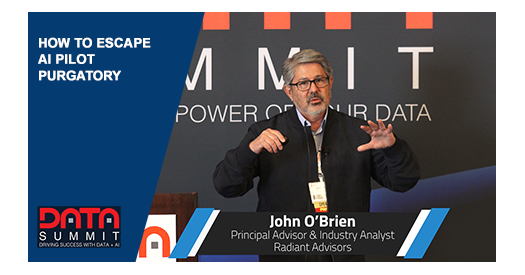
What separates AI projects that reach production from those that stall? In this DBTA article, Radiant Advisors analyst John O'Brien breaks down 2026 AI Market Study findings from Data Summit 2026, pointing to committed AI budgets, traceable model outputs, and automated readiness assessment as markers of production-ready programs. Read the article to see why operational governance is often enough to start moving, and how we can help you apply that thinking.
What separates AI pilots from production-ready AI initiatives?
According to the 2026 AI Market Study presented at Data Summit 2026, organizations that move beyond pilots into production tend to have several concrete elements in place:
- Dedicated AI budget: Production organizations typically commit an AI budget of over $100K, signaling that AI is treated as a strategic capability, not an experiment.
- Traceable model outputs: They ensure AI model outputs are fully traceable—from inputs through to decisions—so teams can verify, audit, and trust the results.
- Automated AI-readiness assessment: They use automated assessments to evaluate whether data, processes, and governance are ready for AI, instead of relying on ad-hoc checks.
John O’Brien’s core message is that AI pilots are not meant to be simply “switched” into production. Instead, organizations need to reimagine how they operationalize AI by investing in budget, traceability, and readiness processes that support long-term, reliable use.
Why is traceability so important for AI success?
Traceability is a recurring theme in the 2026 AI Market Study findings shared at Data Summit 2026. Organizations that are successful with AI in production focus on being able to follow the full path from input to output:
- Verification and trust: Teams need to see which inputs led to which outputs so they can verify that models behave as expected.
- Risk and compliance: Fully traceable outputs make it easier to respond to audits, explain decisions, and manage regulatory or internal compliance requirements.
- Operational reliability: When something goes wrong, traceability helps pinpoint whether the issue is with data, the model, or the surrounding workflow.
As O’Brien puts it, “If you want to do this you have to look at the inputs, you have to look at the outputs.” That level of traceability is what allows organizations to rely on AI in real business contexts, not just in controlled pilot environments.
How much governance do we really need to move AI into production?
The 2026 AI Market Study suggests that organizations do not need to wait for a perfect, enterprise-wide governance framework before moving AI into production.
John O’Brien highlights that “a little governance is better than none.” In practice, this means focusing on operational governance that is specific to how AI is actually used:
- Define which AI agent is doing which workflow in which context.
- Put basic controls around data inputs, model outputs, and how decisions are used.
- Ensure there is accountability for monitoring and improving AI behavior over time.
This kind of targeted, operational governance is often enough to get started and can be expanded over time. It helps organizations reshape their AI efforts from isolated pilots into manageable, production-grade capabilities without waiting for a massive governance overhaul.
How to Escape AI Pilot Purgatory
published by AukPro Solutions
We help companies to build new capabilities with our technology strategy, maximizing business performance by lean digital industry transformation with our next generation SaaS products and delivering sustainable value and impact with automation and subscription based managed services.
We are strategist, technologist, advisers, engineers and transformation leader for solution on amazon aws, microsoft azure, office 365, dynamics365, google cloud & sap for cloud, iot , block chain, bigdata, crm, sales and marketing solutions.
Our subscription based product "CloudsInaBox" brings together next generation technologies for your industry, company and business by redefining business functions on time and on budget with an integrated team of strategist, architects, developers and engineers. We bring value proposition by digital transformation for business and supporting functions with digital strategy, transformation and managed services which benefits in cost reduction, improved business agility and innovation, reduces risks.
Our subscription based product "CSCInaBox" (ColdSupplyChainInaBox) brings together next generation technologies such as block chain, Iot, cloud, bigdata and order management for food and pharmaceutical business. Our food cold chain module brings value proposition by digital transformation and ensures high quality fresh food at every super market, store, restaurants and home. Our pharmaceutical cold chain module brings value proposition by digital transformation and ensures high quality and safe pharmaceutical products for hospitals, medical labs, pharmacies, healthcare facilities such as clinics, outpatient care centers, and specialized care centers. our consumer, buyer, supplier and carrier for food and pharma cold chain can benefit by increase supply chain efficiency,protect your brand and image, maximize marketing campaign,improve quality and safety,reduces waste and losses,improve compliance ,increased transparency,trust and business.





 Sign in with LinkedIn